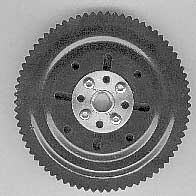
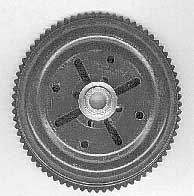
Figure 1 Figure 2
Intro
After seeing yet another objection to democratic voting and independent development in Notes & Quotes (Newsmag 98) I was asked by people who actually know about and accept my hollow rod developments for contra-rotating propellors and the HMS clock hands system, to have a go at smaller geared roller bearings for cranes with a hollow centre to allow cables to pass through as in real life.
I made some enquiries to buy some plates (Parts 168a and 168b) as separate items. I discovered a lack of availability of new or second hand ones and that obsessive purist collectors with money to waste are as usual artificially inflating prices of complete thrust races to obscene levels for the sake of arrogance and elitism.
I decided to do something more positive
than simply accept it and publish my findings for D.I.Y. Model Engineers
WITH Meccano. Those in the hobby who say my modifications cannot
be achieved by everyone should note that in accordance with standard model
making and DIY practice drawings, sketches and notes etc can be provided
to model engineers WITH Meccano or I can make the parts for them!!
Four inch G.R.B. Developments - Mark 1
NOTE: For 168 Mk 1 conversion special offer, see the front page of current MECAREP brochure.
Figures 1 & 2 show the Mk 1 developments featuring the first modifications that I made to a standard 168 assembly, for which a hollow centre bearing was developed. The plates are bored out in the centres to Ø 0.625" as per details below.
Figure 1
Figure 2
The gear shown in Fig 3 is a 27B with the boss removed and the centre bored to Ø 0.625" + 0.002" for a running fit on Mecarep part A Ø 0.625" Hollow Centre Bearing.
The bearing is made from a standard 8 hole wheel disc fitted with a 0.812" long x Ø 0.625 " Brass boss with a Ø 0.375" hole through the centre (Part A).
Part B is a 0.875" OD Collar to hold the bearing together on assembly.
The ball cage is sandwiched between the gear and plate in the usual manner.
The 27B can be replaced with a similarly
modified Ø 4" Ashok or Exacto 152T gear or gear plate
STANDARDISATION OF MATERIALS: The
Ø 0.875"material for the original ring is the same as that used
for Dave Taylor’s GRB rollers and will be used for modified eccentrics.
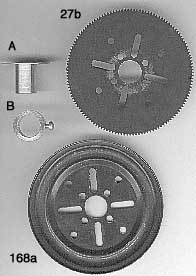
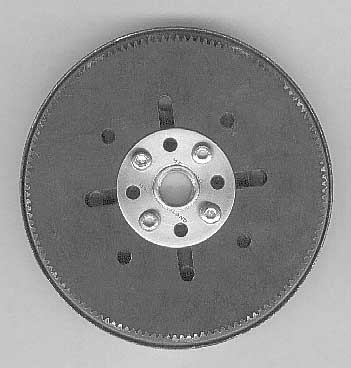
Figure 3 - The parts
Figure 4 - The complete assembly
The GRB can be driven either by a pinion or a Mecarep Small Worm as shown in Fig 5. Details: 0.437" dia Brass, Ø 0.375" x 0.25" boss length and 0.5" length of worm. An even smaller worm will be developed shortly.
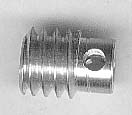
Figure 5 - Mecarep Small Worm
Another type with a 96mm Dia grooved 32DP
Delrin gear and pinion set is being considered for toothed plate replacements.
The advantage of Delrin being reduced Coefficient of friction than that
of the standard steel on steel Meccano thrust race which, in my opinion,
is of very limited use.
Four inch G.R.B. Developments - Mark 2
Taking the developments a stage further, many cranes have a ladder built into the centre of the main structure for the operator to gain access to the control cabin, so I have addressed this factor and developed an inexpensive 4 inch version for scale models made WITH Meccano.
Figure 6 shows a Hobby’s TT3 Three inch turntable bearing fitted to a French 152T special gear ring bought at Skegness in 2002 but I am unable to obtain any others as yet. Figure 7 shows the end view of the assembled GRB fitted with the original plate prior to having the centre enlarged. I call these the Mk 2 developments
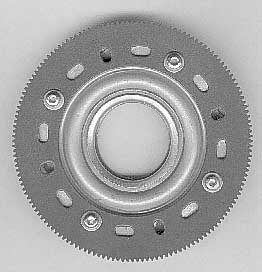
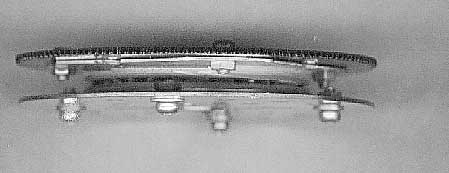
Figure 6
Figure 7
4" Exacto Gear plates or 4" Ashok 152T gears can be bored out to either Ø0.625" for the Mk 1 GRB or to Ø 1’25" for the Mk 2 type and I have bored out a 133T Meccano gear for use with a smaller diameter slip ring GRB which is described later. The lower plate is a special 16SWG circular plate, Ø 3.375" with 16 alternate clearance and Meccano threaded holes on 3" and 2" PCD’s - See Fig 8, top left .
The TT3 Bearing ring is 8mm thick and will withstand a load of 200lbs and the overall thickness is 0.540" but this can be reduced to 0.420" by assembling the modified TT3 inside a Ø 3.5" Wheel flange bored to Ø 0.625" centre fitted with hank bushes and the same gear. See Fig 9.
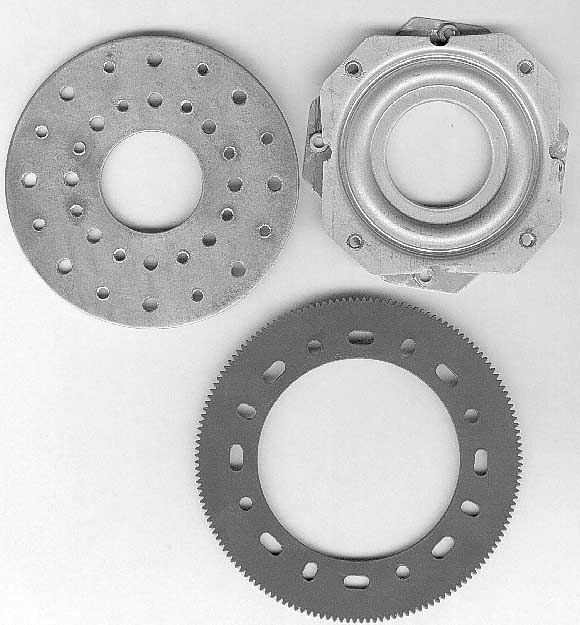
Figure 8
Top Right, shows the Hobby’s ring with 8 captive nuts fitted. These are an added advantage in that no nuts are needed to secure the bearing, which makes life simpler for assembly especially if it is to be mounted inside a 3.5 " wheel flange or a 143a flanged ring - See Fig 9.
Fig 9 shows the Mk 2 fitted with a modified 27B gear which has 16 holes on 3" PCD clearance and threaded alternately for greater versatility on assembly. The 3.5 " wheel flange is fitted with 4 hank bushes on the inside. The TT3 is modified as described in the DIY article below and fitted to the wheel flange with bolts only. The overall height of this assembly disregarding bolt heads is 0.420" and the hollow centre bearing is not needed.
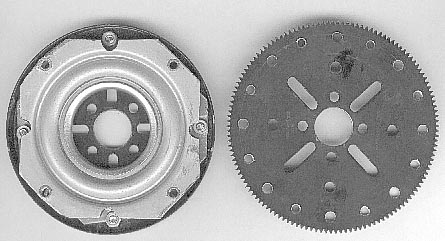
Figure 9
Four inch G.R.B. -- Mark 3 Developments
DOCTOR CHEAPO’S - No Balls - Geared "Rolling" Bearings -- but, for rolling read sliding !
The modified 27b Gear as used in Fig 9 is also used on the bearing shown in Fig 10 below. It revolves on, and is supported by, a plastic slip ring, the movement of which is limited by 4 Meccano plastic rollers serving as centring bearings. The overall thickness of this GRB is 9.5mm disregarding the bolt heads.
The rollers are counter bored 7mm Dia x
3.5 mm deep to suit Meccano hexagonal nuts and these are bolted so the
collars do not rotate but allow the ring to revolve freely.
The slip ring is 7mm wide and is machined from the centre (thick walled)
portion of a 68 mm Plastic straight coupling used for joining 2.5" Gutter
down pipes.
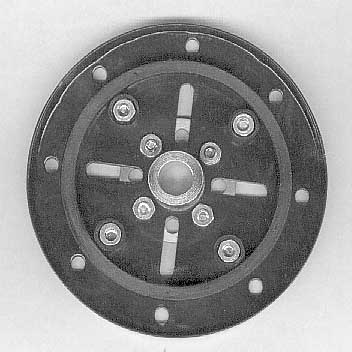
Figure 10
Fig 11 below, shows the parts used in my second design of Doctor Cheapo’s No balls GRB and this is perhaps the slimmest practical bearing that can be used on a model crane. The advantage of having a Polypropylene or Nylon slip ring principle rather Delrin is that there is possibility greater control of movement. A Delrin slip ring has a very low co-efficient of friction and is therefore like a conventional ball or roller system in that both systems need some form of braking or other control such as a worm drive to limit possibility of over-run.
Anti Clockwise from the top-right:
A - 16SWG ring described previously (Ref
A Fig 8)
B - 27B with 16 holes on 3" PCD (8 alternate
clearance and Meccano threaded)
C - 0.250" thick Nylon slip ring Ø
1.378" bore x 1.450" OD with a 0.2" wide x 0.2" deep channel machined into
it to take 24 Small black plastic Meccano rollers if desired, but this
method increases the overall thickness to 0.440"
D - Brass Ø 1.5" x 1.375" shouldered
centre bearing x 0.6" overall length. Bore 1.25"
E - Retaining ring - Ø
1.5" x Ø 1.375" x 1/8" wide, fitted with two x 8 B.A. grub screws.
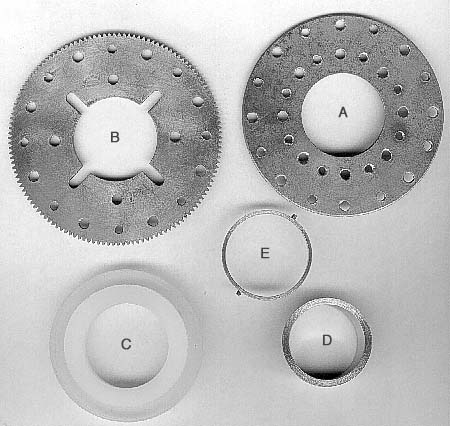
Figure 11
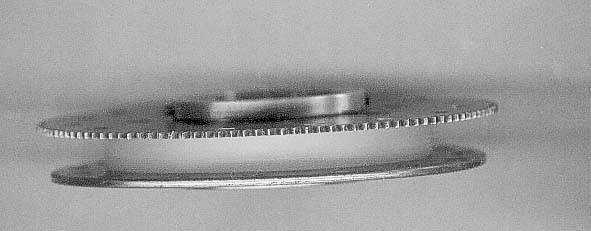
Figure 12 - The assembled Doctor Cheapo
Big Hole bearing - Full Size
HOBBY'S TT3 Modification - DIY Notes
© Mike Dennis May 2004
In order to convert this part for use as the bearing for a miniature geared roller gearing, I have marked in sequence the letters A, B & C on the actual item, two views of which are shown, half size approx in Figs A & B - The letters correspond to the sequence of operations for conversion as carried out by me. Meccano parts required - 4 off 0.5" bolts nuts and black plastic standard diameter spacers.
IMPORTANT NOTE : Before carrying out any work it is VITAL to mask off the ball race part between the plates before any drilling or filing is carried out unless you are fortunate enough to have access to a high pressure airline to blow the muck and swarf out from the assembly after mutilation !!
Operation 1: Fit four x standard Meccano plastic spacers between the plates and secure them tightly with four x 0.5 " long Meccano bolts and nuts - They come in handy - even for heretics!
Operation 2: A - Refers. Using a Ø 5mm drill bore out the pilot holes and follow through on the second plate and de-burr all holes inside and out.
Operation 3: B - Refers. Mark the plate at the centre line on all four edges and file 0.375" wide semicircular notches in both plates at the same time to 0.25" deep using a large Rat tail (Round) file.
NOTE: Before carrying out operation 4 ? Remove and re-fit the spacers, nuts and bolts one by one through the enlarged holes A, to carry out the final operation.
Operation 4: C - Hold the assembly in the
vice across the bolt heads and ends only to avoid excess pressure on the
bearing which could cause partial seizure. Cut off the four corners from
the original plates to 1mm from the edges of holes A and blend radius the
corners. with a file so that the assembly fits the inside of a 3.5 " wheel
flange if desired. De-burr all edges using a suitable file, remove
all swarf and finally, remove the masking.
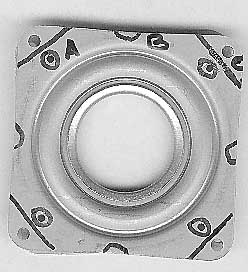
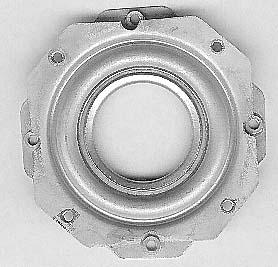
Figure A
Figure B
OPTIONS
The view on the right shows 8 captive
nuts fitted. These are an added advantage in that no nuts are needed to
secure the bearing, which makes life simpler for assembly especially if
it is to be mounted inside a 3.5 " wheel flange or a 143a flanged
ring.
The captive nuts are also called "hank bushes" or "Riv-nuts" and can be made from 4 B.A. full nuts by running the thread through with a 5/32" Whitworth tap, countersinking the face to be worked on and machining a 5mm Dia. shoulder x half the nut thickness on that face. They are then ready to be fitted to the A holes in each plate, which are drilled to 5mm Dia. The nuts are riveted in as appropriate using a 5mm thick piece of mild steel scrap as a distance piece between the flanges while riveting in position.
Happy Mutilating !!
NOTE:
The current HOBBYS catalogue price for
the TT3 (3" Turntable bearing ring) is £2.70 (Page 38 refers) and
the maximum load as stated in the information chart is 200lbs (90Kg). Website:
www.hobby.uk.com, orders online, payment by card.
The catalogue comes out every year around
August and is well worth getting!